

On Wednesday, July 22, 2026, the Texas grid pulled a preliminary 91,308 MW at 5 p.m. That is the most electricity ERCOT has ever served in a single moment. The old record, 85,508 MW, had stood since August 2023. This one beat it by 5,800 MW in one afternoon, a jump on the order of several large power plants' worth of output.
TL;DR:
ERCOT broke its all-time demand record twice in two days during a July heat wave, topping out at a preliminary 91,308 MW. Unlike the near-miss of August 2023, the grid handled it with no emergency alerts and more than 10 GW of reserves to spare. The heat is why the record happened this week, But the load has been climbing for other reasons, mostly data centers, and ERCOT expects that growth to carry peak demand toward 367,790 MW by 2032.
Quick FAQ
Is 91,308 MW the official record now?
No. It is preliminary and unofficial. Real-time demand reported during an operating day goes through final settlement before ERCOT confirms an official record, and that verified number will not be published until later. Expect the final MW to change, usually by a small margin.
Does this record change coincident peak (CP) exposure for this year?
Potentially, yes, but not on its own. Transmission cost allocation keys off the CP hours in the relevant peak window, not off a single all-time instantaneous record. A July record raises the odds that one of your 4CP intervals lands in this window, but the settled CP is what allocates cost, and that is determined after the fact.
If demand hit a record, why were there no emergency alerts?
Because EEA triggers key off operating reserves, not off gross demand alone. Reserves stayed above 10 GW through the peak, far above the Level 1 threshold of 2,300 MW. A record demand day with a comfortable supply looks nothing like a tight day at lower demand. The 2023 record was tighter at a lower absolute number precisely because the reserve margin essentially defines stress among other factors.
Is peak demand growth the same thing as energy (MWh) growth?
No, and the distinction matters for anyone modeling revenue or reserve adequacy. Peak demand (MW) is the instantaneous maximum the system must serve. Energy (MWh) is consumption over time. Data center load raises both, but its high, flat load factor pushes energy and baseload up more steadily than it spikes the peak. The 367,790 MW figure in ERCOT's long-term forecast is a peak-demand projection, so read it as a capacity-adequacy signal, not a consumption total.
The record fell twice in 48 hours
ERCOT saw this coming. On July 20, its summer outlook already flagged a possible peak between 90,500 and 98,000 MW, well past the 2023 mark. The forecast landed almost to the day.
Here is how the two days stacked up against the prior record.
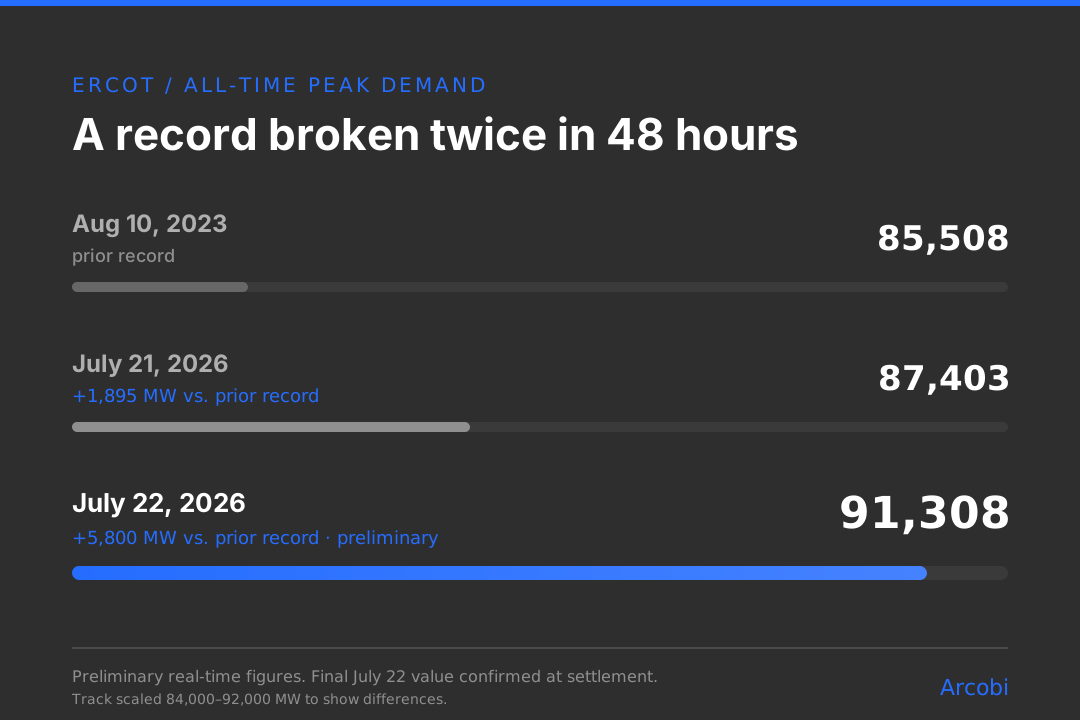
Tuesday already broke the three-year-old record by nearly 1,900 MW. Then Wednesday broke Tuesday's by almost 4,000 MW more.
By 3 p.m. Wednesday, real-time demand read 90,027 MW against 113,543 MW of available generation. Demand kept climbing into the early evening and peaked around 5 p.m. at a preliminary 91,308 MW on ERCOT's real-time instantaneous reading.

Our own system-wide demand on an hourly basis put the peak hour at 91,166 MW. The roughly 140 MW gap is the normal difference between an instantaneous spike and an hourly-integrated value, so both numbers describe the same event at different resolutions.
One caveat for anyone doing settlement work. These are unofficial, real-time figures. ERCOT's spokeswoman Trudi Webster, cautioned that the number is subject to revision, since demand reported during an operating day goes through final settlement before it becomes the official record. That verified figure for July 22 will not be confirmed for a while.
What actually drove the high demand
Two things, operating on completely different timescales.
The immediate trigger was heat:
Large parts of Texas ran into the upper 90s and past 100°F, with heat index values as high as 108°F in some regions. That pushed air-conditioning load to levels the state had not seen. A tropical system developing in the Gulf added atmospheric stress that grid operators tracked all week.
The slower, more important driver is structural:
Texas demand is shifting up its whole baseline, and weather is now landing on top of a much higher floor. ERCOT's April 2026 long-term forecast projects demand reaching roughly 367,790 MW by 2032. That is more than four times Wednesday's record. The growth comes overwhelmingly from data centers, with crypto mining, EV adoption, and industrial and oil-and-gas expansion filling in the rest.
The clearest signal sits in the interconnection queue:
ERCOT entered 2026 with more than 233 GW of large-load requests, up 269% year over year. Data centers make up about 77% of that queue. So when ERCOT's summer outlook pointed at a 90,500 to 98,000 MW peak, it was pricing in load that had already connected or was queued to, not just betting on a hot week.
Why this record looks different from the 2023 event
The 2023 record came with white-knuckle reserves and a grid that flirted with emergency conditions. This one did not.
ERCOT issued no Energy Emergency Alerts across the July 21 and 22 peaks. Reserves stayed above 10 GW even at the moment the record was set. For reference, the alert thresholds sit far lower: Level 1 triggers below 2,300 MW of reserves, Level 2 below 1,750 MW, Level 3 below 1,430 MW.
ERCOT's weekly outlook had forecast capacity beating demand by more than 30 GW on most days that week. Even the tightest projected moment, Wednesday around 9 p.m., still showed roughly 98 GW of capacity against about 84 GW of demand.
The grid had a quiet run into this event. ERCOT went the entire summer without breaching 80 GW of peak demand, helped by mild actual temperatures that mostly stayed under 93.9°F through July. Demand response did real work, curtailing roughly 2 to 3 GW to cap earlier peaks just under 80 GW.
Behind that, ERCOT has kept building. A larger base of dispatchable and renewable generation, plus about 3,500 MW of demand response capacity for summer 2026 (around 4% of normal peak demand), gave the system room to absorb a record spike without a single reliability incident.
ERCOT spokeswoman Trudi Webster said the grid "operated under normal conditions" through the peak, with generation brought online early to guard against sudden swings.
The important aspect of the event
ERCOT's own May 2025 Capacity, Demand and Reserves report found summer planning reserve margins declining sharply from 2026 through 2030, crossing into negative territory as early as 2026 or 2027 for peak net-load hours.
Negative reserve margin means projected demand can exceed projected supply at the tightest hours. It doesn't guarantee outages, but it does mean the cushion ERCOT plans around is shrinking, and the CDR has it shrinking every year through 2030.
Federal regulators reached a similar conclusion. The FERC Summer 2026 reliability assessment expected electricity consumption to top every one of the prior five summers.
The price side carries the same message. The EIA has warned that data-center-driven demand could push ERCOT North Hub wholesale prices as much as 79% above baseline in a high-demand scenario. ERCOT and PJM are expected to see the fastest data-center load growth of any U.S. grid region through 2027.
So you have a grid that just proved it can serve 91 GW without breaking a sweat, sitting on a demand curve that could push several multiples higher within the decade, against reserve margins already projected to tighten. Both things are true at once.
What this means if you operate in ERCOT
A few takeaways worth noting -
If you are a C&I buyer, this is a good observation. A higher demand floor means summer peaks arrive earlier and settle higher. Coincident peak exposure gets more expensive to guess wrong on, and the window to curtail correctly gets tighter.
If you run storage or dispatchable assets, the gap between a calm record and a negative reserve margin forecast is exactly where value lives. Days like July 22 stay quiet until the margin math flips, and the CDR report says that math is flipping soon.
If you are tracking the data center story, the 233 GW queue and its 77% data center share are the number to watch, not the weather. Heat sets the record date. Load growth sets the record height.
The forever peak of July 22 will not be forever. On this trajectory, it may not even last the summer.
Some Related Cases
.png)


Let's explore your energy challenge together.
Every energy challenge is different. Tell us yours, and
we'll show you what 25 years of market intelligence can do.