
Your Market Position Starts With the Right Forecast
Arcobi forecasts price, demand, and grid conditions so your market participation strategy and asset operations run from the same intelligence. PQ pair construction, bid timing, and positioning decisions all draw from one live layer.
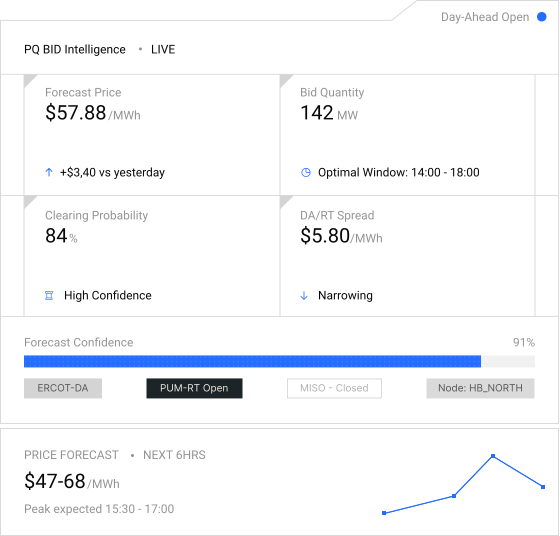
The Intelligence Layer Between Forecast and Bid
Market participation decisions — when to bid, at what price, with which assets — require accurate forward-looking intelligence. Arcobi AI Forecasting provides that intelligence and structures it directly into the inputs that drive participation: Price-Quantity pairs, bid timing windows, and asset positioning against expected market conditions.
The result is a market participation strategy built on what the market is likely to do, not on what it did yesterday.

Participation Without Intelligence Is Guesswork
Every bid submitted to a wholesale market carries a price and a quantity. The quality of that bid depends entirely on the quality of the intelligence behind it. Underpricing means leaving value on the table. Overpricing means missing the clearing window. Both are expensive, and both are avoidable with accurate forecasting. When market strategy and asset operations draw from separate information sources, the gaps between them cost money.
When they run from one intelligence layer, decisions compound rather than conflict.
The Decisions That Determine Market Value
Five participation decisions, each of which compounds when it runs from accurate forward intelligence instead of historical data or rules of thumb.


A PQ pair defines both the price at which you are willing to sell or curtail, and the quantity you can deliver at that price. Arcobi forecasts the price and demand conditions that determine whether those parameters will clear, giving your bids a higher probability of hitting the target.


Day-ahead and real-time participation windows are distinct, and the intelligence that informs each one is different. Arcobi forecasts align to those windows, so the right intelligence reaches decision-makers at the right moment in the bidding cycle.


Which assets participate, when, and in which markets depends on their availability, cost structure, and the expected value of each market window. Arcobi forecasts provide the market side of that calculation. When both sides are in one system, positioning decisions are better coordinated.


For organizations enrolled in demand response programs, participation decisions are shaped by expected activation conditions. Arcobi forecasts of grid stress and demand conditions inform when enrollment and active participation are most valuable.


Organizations with multiple assets or locations need participation decisions to be coherent across the portfolio. Arcobi provides a shared intelligence foundation so that generation, storage, and flexible load assets are not working against each other in the same market window.
From Live Intelligence to Structured Bid
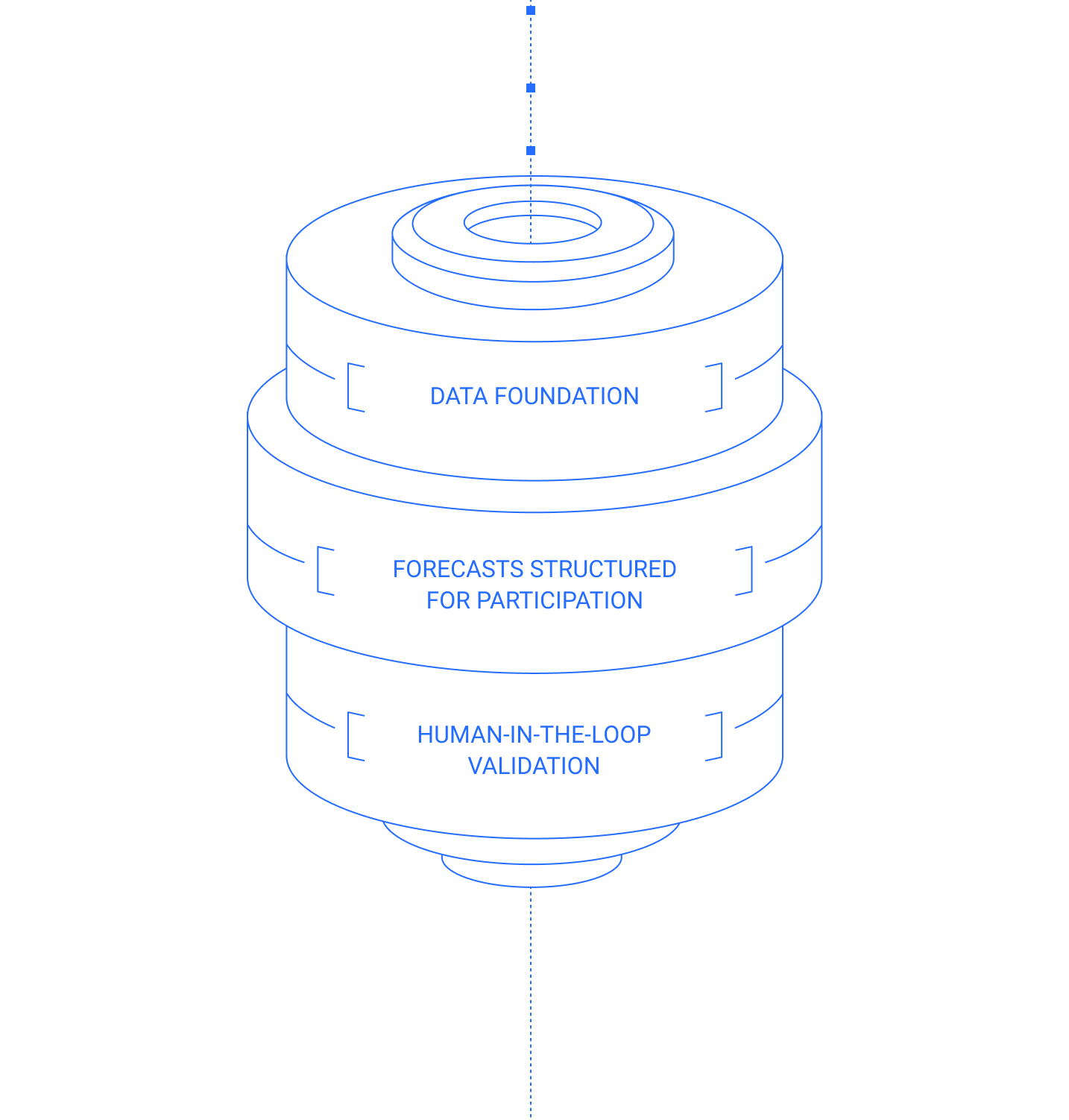
Data Foundation
DataHub holds 25+ years of curated North American power market data across all major ISOs: wholesale prices, grid metrics, demand data, generation availability, weather drivers, and 33,000+ streams. Arcobi originates this data directly. Every forecast model trains on this foundation.
Forecasts Structured for Participation
AI forecasting produces short-term predictions for price, demand, and grid conditions across day-ahead and real-time markets. PQ pair parameters, timing windows, and asset positioning recommendations surface in the same platform where strategy is built and decisions are made.
Human-in-the-Loop Validation
AI produces the forecasts. Domain experts validate outputs during unusual market conditions, regulatory interventions, and significant weather events. The combination of automated intelligence and expert judgment produces more reliable participation inputs than either alone.
What Better Market Intelligence Delivers
How operators, traders, and energy managers use it across North American markets.
PQ pairs built on historical averages rather than forward-looking conditions
Price and demand forecasts for the relevant market window — at the level of nodes and hubs — inform PQ parameters that reflect expected clearing conditions rather than past prices.
Day-ahead bids submitted without forward visibility into real-time conditions
Day-ahead price forecasts combined with demand and grid conditions give you time and price positions with awareness of how the real-time market is likely to settle.
Assets across a portfolio participating without coordination
Shared price, demand, and grid condition intelligence across all relevant markets and locations enables alignment of generation, storage, and flexible load to one market view.
Demand response enrollment and participation made without grid condition context
Forward visibility into the grid stress conditions that precede demand response activations informs enrollment in programs where activation probability justifies the operational commitment.
Bid timing missing the highest-value market windows
Forecast intelligence aligned to day-ahead and real-time market schedules positions assets and submission timing when forecast conditions indicate the best opportunity.
Asset operations and market strategy running on disconnected information
One intelligence layer covering price, demand, and grid conditionsfor both participation and execution planning coordinates dispatch timing, curtailment, and procurement against the same forward view.
Built for Organizations With Assets in the Market

Operators managing dispatchable generation, battery storage, or flexible load need forward intelligence to bid effectively. PQ pair construction grounded in forecast conditions produces better bids than rules of thumb built on history.


Large commercial and industrial organizations with dispatchable assets or demand response enrollment participate in markets whether they have a trading desk or not. Arcobi provides the intelligence that makes that participation systematic rather than reactive.


Organizations managing demand-side flexibility need to know which market windows reward participation and which do not. Forecast intelligence identifies those windows clearly and structures participation decisions around them.


Teams responsible for procurement strategy across multiple ISOs benefit from a shared intelligence layer that updates with market conditions rather than relying on internal models built on older data.


Retail providers managing load risk across customer portfolios use participation intelligence to tighten hedging strategy, improve procurement timing, and manage exposure to intraday volatility.
What Makes This Different
Forecasting Built for Participation, Not Just Reporting
Most forecasting tools produce outputs. Arcobi produces outputs structured for the decisions that matter in wholesale market participation. PQ pair construction, bid timing, and asset positioning are first-class use cases.
Proprietary Data at the Foundation
Arcobi’s models train on 25+ years of market data originated directly, across 330,000+ streams and all major North American ISOs. Signal depth that tools built on public ISO feeds cannot replicate.
One Intelligence Layer for Strategy & Operations
Market participation strategy and asset operations are most effective when they share the same forward view. Generation, storage, load, and procurement decisions draw from one source rather than disconnected tools producing conflicting signals.
Human Judgment Where It Counts
AI generates the forecasting inputs. Domain experts validate outputs under unusual conditions. The combination produces participation intelligence that is both fast and reliable across normal and edge-case market conditions.
Accuracy Internal Models Cannot Match
Internal models are constrained by available data. Arcobi’s models train on proprietary market data, proprietary weather instrumentation through Climavision, and direct market participant behavior signals — a combination internal teams cannot independently replicate.
What Forecast-Driven Participation Delivers
Disciplined participation decisions grounded in accurate peak and price forecasting leads to better bid construction, more precise timing and portfolio positions that reflect where the market is going rather than where it has been. These are the compounding advantages of participation intelligence that updates with the market.
$1B+
28%
$350K
Frequently asked questions
What does onboarding look like?
Arcobi configures forecasting models and participation intelligence for your markets, assets, and operational objectives. Built for rapid deployment with minimal integration overhead.
Is this available standalone or does it require other Arcobi products?
The forecasting intelligence and PQ pair inputs are available standalone. Additional Arcobi products add automated execution and broader data access when you are ready to expand.
Can this support multiple assets and locations?
Yes. Arcobi provides portfolio-level market intelligence across multiple assets, ISOs, and market structures. The platform is built for organizations with complex, multi-location participation needs.
What is the accuracy advantage over building internal forecasting models?
Internal models are constrained by the data available to build them. Arcobi's models train on 25+ years of proprietary market data, proprietary weather instrumentation through Climavision, and direct market participant behavior signals — a combination that internal teams cannot independently replicate.
How does this integrate with existing bidding workflows?
Forecasts and participation inputs are delivered via dashboards, REST API, and scheduled exports. Arcobi is designed to fit into existing operational workflows rather than replace them.
Which markets does this cover?
Major North American ISOs and power markets. DataHub covers 33,000+ streams across ERCOT, AESO, CAISO, PJM, MISO, NYISO, SPP, ISO-NE, IESO, CENACE, plus FERC, NERC, and WECC regions. Contact us for specific market availability.
Build Your Market Position on Accurate Intelligence
Arcobi turns uncertainty into opportunity for everyone who touches a wire. Market Participation Strategy is the layer that connects forecast to bid to outcome.