

How to Avoid Coincident Peak Charges in PJM
How do I avoid coincident peak charges in PJM? It's a question that costs large electricity users real money every summer, because in PJM, just five hours of summer electricity usage lock in your capacity charges for the entire following year. Many customers find the exact 5CP hours are not known with certainty until after the summer, and by then, the damage is already done.
This guide breaks down exactly how PJM's coincident peak system works, how to identify the hours that put you at risk, and the specific steps to reduce your Peak Load Contribution before next summer's peaks hit. Whether you run a manufacturing plant, a data center, or a large commercial portfolio, the stakes are concrete: in the 2025/2026 delivery year, PJM's RTO capacity price cleared at $269.92 per MW-day, which translates to roughly $98,500 per MW of Peak Load Contribution per year.
In constrained zones like BGE, that figure climbs to over $170,000 per MW annually. At those rates, a 5 MW site in the RTO zone faces roughly $492,000 in annual capacity cost exposure, and over $850,000 per year in BGE territory. Missing even one coincident peak can mean six figures in avoidable charges locked into your bill for the next twelve months.
How PJM's 5CP system sets your capacity bill
The five hours that determine your annual charge
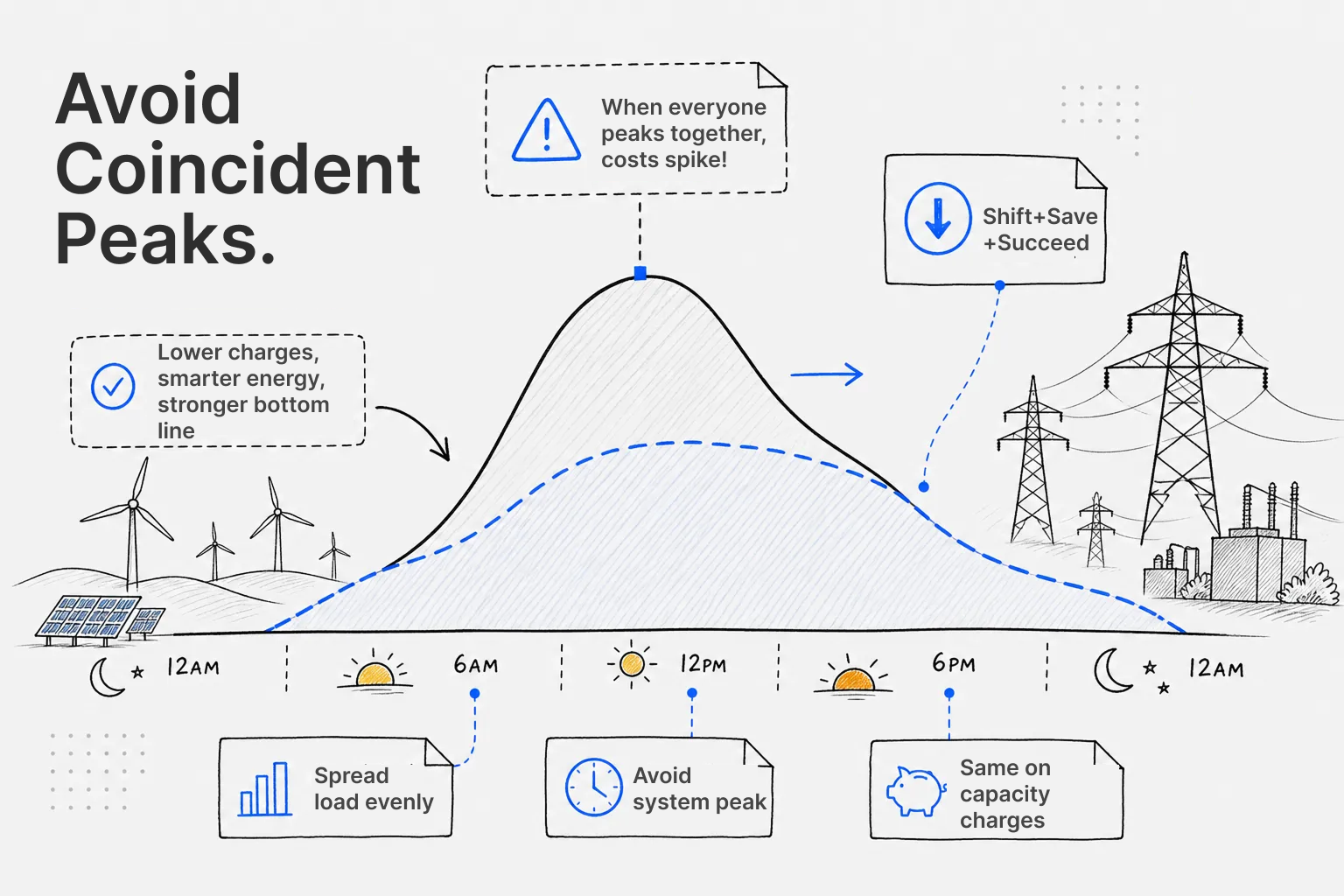
PJM identifies the five highest system-wide peak demand hours between June 1 and September 30 each year. These five hours must fall on separate non-holiday weekdays, and PJM's own data confirms just how consistent the timing is: all five of PJM's 2024 coincident peaks landed at Hour Ending 18:00, meaning 5:00 to 6:00 PM Eastern. Your meter readings during those exact five hours, averaged together, become your Peak Load Contribution (PLC), also called your capacity tag.
That number follows you into the next PJM planning year and drives your transmission capacity charges across your entire billing cycle. Note that while PJM sets the PLC, final charge calculations can vary by Electric Distribution Company and zone, so verifying your zone-specific rules with your EDC is worthwhile.
Why missing one peak hurts more than you expect
Your PLC is calculated as the simple average of five readings. If you reduce load during four of the five peak hours but are caught running full tilt during the fifth, that one high reading pulls your entire average up, and the math is unforgiving. Reducing your average load across all five hours, even modestly, compounds into savings that flow through every month of the following year's bills.
When do I face coincident peak charges in PJM?
The seasonal and time-of-day pattern to know
PJM's five coincident peaks almost always occur during heat-driven demand surges: late-afternoon hours between 2 PM and 7 PM on the hottest non-holiday weekdays of summer. The 2024 peaks confirm this pattern precisely, with every event landing at 5:00 to 6:00 PM on days scattered across June, July, and August. Temperature and heat index are the dominant variables, which means your peak demand charge risk window is tightly correlated with regional weather forecasts, not a fixed calendar date you can schedule around in advance.
The forecasting gap where most facilities lose money
PJM publishes hourly load forecast data, and AI-driven forecasting models can predict likely peak windows with meaningful accuracy: day-ahead forecasts can come within 0.3% of actual load, and machine learning approaches can identify the coincident peak hour with an error of at most one hour. But even that precision means the exact peak window can shift by 60 to 90 minutes depending on weather variability.
Without an active monitoring system feeding you updated predictions before the event, you're relying on guesswork for a decision that sets your bill for an entire year. Many facilities that overpay in capacity charges aren't unaware of 5CP; they simply don't have a reliable signal early enough to act on it.
How to avoid coincident peak charges in PJM: Step 1, Get days-in-advance warning
What separates a useful alert from background noise
A generic weather alert or a PJM data dashboard doesn't give you what you actually need: a ranked probability that the next 24 to 72 hours will produce a coincident peak event, combined with an estimated peak window and a recommended curtailment target. Useful alerts account for PJM system conditions, regional heat index forecasts, historical peak-hour patterns by zone, and real-time load trends simultaneously.
Without that combination, teams either over-respond and curtail unnecessarily on false alarm days, or wait too long and miss the window when it counts. This is what distinguishes a purpose-built peak notification program from a standard data feed.
How Arcobi delivers 5CP predictions before the peak arrives
Arcobi addresses this directly. The platform's AI-driven forecasting engine monitors PJM system conditions continuously and integrates weather and demand signals to flag likely coincident peak windows days in advance, not hours. When conditions align with a probable 5CP event, Arcobi sends a prioritized alert with enough lead time for your team to schedule pre-cooling, stage equipment, or activate demand response assets before the peak registers on your meter.
For large commercial and industrial customers whose entire annual capacity charge hinges on a handful of late-afternoon hours, that advance window is where the money is won or lost.
How to avoid coincident peak charges in PJM: Step 2, Operational tactics that cut your load
Pre-cooling, pre-chilling, and thermal load shifting
Pre-cooling is one of the most effective and lowest-cost 5CP tactics available to any facility with significant HVAC load. The approach is straightforward: push your cooling system hard in the hours before a predicted peak, lower your space or process temperature below your normal set point, and then let the thermal mass of the building or process absorb heat during the peak window while your HVAC system idles. PJM demand response program data indicates that cooling loads can be reduced by as much as 70% per customer during a three-hour curtailment window when pre-cooling is properly executed. That kind of load reduction, applied consistently across all five coincident peak hours, moves the needle on your PLC and supports meaningful peak demand charge reduction.
Staggering equipment start-ups and compressors
Large compressors, chillers, and industrial motors represent significant coincident demand risk when they cycle on simultaneously after a setpoint recovery. Staggering equipment start-ups across a 15 to 30-minute window instead of allowing them to restart in a cluster meaningfully reduces your metered demand during a peak hour. Boiler and compressor staging combined with scheduling controls has delivered documented energy savings exceeding 900,000 kWh annually at multi-building campuses, alongside significant reductions in gas costs from eliminating simultaneous heating and cooling in the same facility.
Enrolling in PJM demand response programs for compensated curtailment
PJM's Emergency Load Response Program (ELRP) compensates customers through a Curtailment Service Provider when they reduce load during dispatched events. When an ELRP event overlaps a coincident peak hour, two things happen at once: you earn a payment for curtailing, and you reduce the load reading that feeds your next year's capacity tag, a direct form of capacity charge mitigation. Enrolling requires identifying curtailable load, working with a CSP to register your site, and confirming your response capability. Enrollment timelines vary by CSP, but contacting a CSP or your local EDC before June is the right move to protect next summer's PLC.
Step 3: Automate your curtailment response so nothing is left to chance
Why manual response fails on peak days
Peak days are operationally chaotic. Temperatures are high, production schedules are full, and facility teams are handling competing priorities. Expecting a team member to manually execute a curtailment sequence accurately during a narrow one to two-hour window, based on a text alert, is a plan that fails more often than it should. Operational experience across PJM facilities consistently shows that even well-trained teams can miss optimal curtailment timing, sometimes by enough to leave a high demand reading on your meter during the hour that matters most.
Closing the loop with automated load curtailment
Arcobi converts its peak predictions into direct asset-level actions. When the platform identifies a high-probability 5CP event, it can automatically trigger pre-programmed load curtailment sequences across your facility or portfolio, with no manual step required. Every automated action is logged with a full audit trail, so your energy team can review exactly what happened, when, and at what load level. For PJM customers with multiple sites or complex equipment dependencies, that combination of advance warning plus automated execution is what turns a coincident peak avoidance strategy from a spreadsheet exercise into a reliable, repeatable process that performs consistently across all five peak events each summer.
When battery storage or on-site generation makes sense for 5CP
Sizing BESS specifically for coincident peak avoidance
Battery storage doesn't need to run many hours to deliver 5CP value. Analysis of historical PJM 5CP data shows that a 2-hour battery can capture the majority of coincident peak events when paired with accurate forecasting and reliable dispatch. A 4-hour system offers more buffer when peak timing is less certain or when the site also needs broader peak-shaving or resilience capability. The key variable is dispatch certainty: a battery that fires on the wrong hour delivers no 5CP benefit, which is exactly why pairing storage with an intelligent forecasting platform matters as much as the battery hardware itself.
ROI logic for facilities with high capacity exposure
The business case for BESS in avoiding coincident peak charges in PJM is strongest when three conditions align: the facility carries a large PLC relative to its average load, capacity prices in its PJM zone are elevated, and it has limited operational flexibility to curtail through behavioral or HVAC tactics alone. At current installed cost ranges of roughly $250 to $580 per kWh for commercial systems, the ROI math can be compelling. Combined annual savings from 5CP avoidance and complementary demand charge reduction can support a payback horizon of three to ten years depending on zone, battery sizing, and capture consistency. Stacking ancillary service revenue on top of the avoided capacity charge strengthens the ROI further, assets connected to an automated dispatch layer can respond to market signals without manual oversight, stacking ancillary revenue across multiple value streams.
The bottom line on protecting your PLC
Reducing PJM coincident peak charges requires advance warning, a ready curtailment plan, and reliable execution when it matters. The math of 5CP is simple, the timing is predictable within a defined seasonal window, and the tactics, from pre-cooling to BESS to demand response enrollment, are proven at scale. For most large electricity users, the gap isn't strategy; it's execution.
Arcobi delivers the advance intelligence and automated response capability that PJM customers need to protect their capacity tags every summer. The platform connects market signal to asset action automatically, with full auditability and configurable controls that work across all asset types in a single integrated stack.
If your facility hasn't modeled its current 5CP exposure or built a curtailment playbook, the next summer peak season is the right deadline to work backward from. Explore Arcobi's coincident peak forecasting and automated dispatch capabilities and see what your PLC reduction potential actually looks like before the next June window opens.
Some Related Cases
.png)



Let's explore your energy challenge together.
Every energy challenge is different. Tell us yours, and
we'll show you what 25 years of market intelligence can do.