
ISO Standards Database vs. ISO Market Data: What Energy Professionals Need to Know


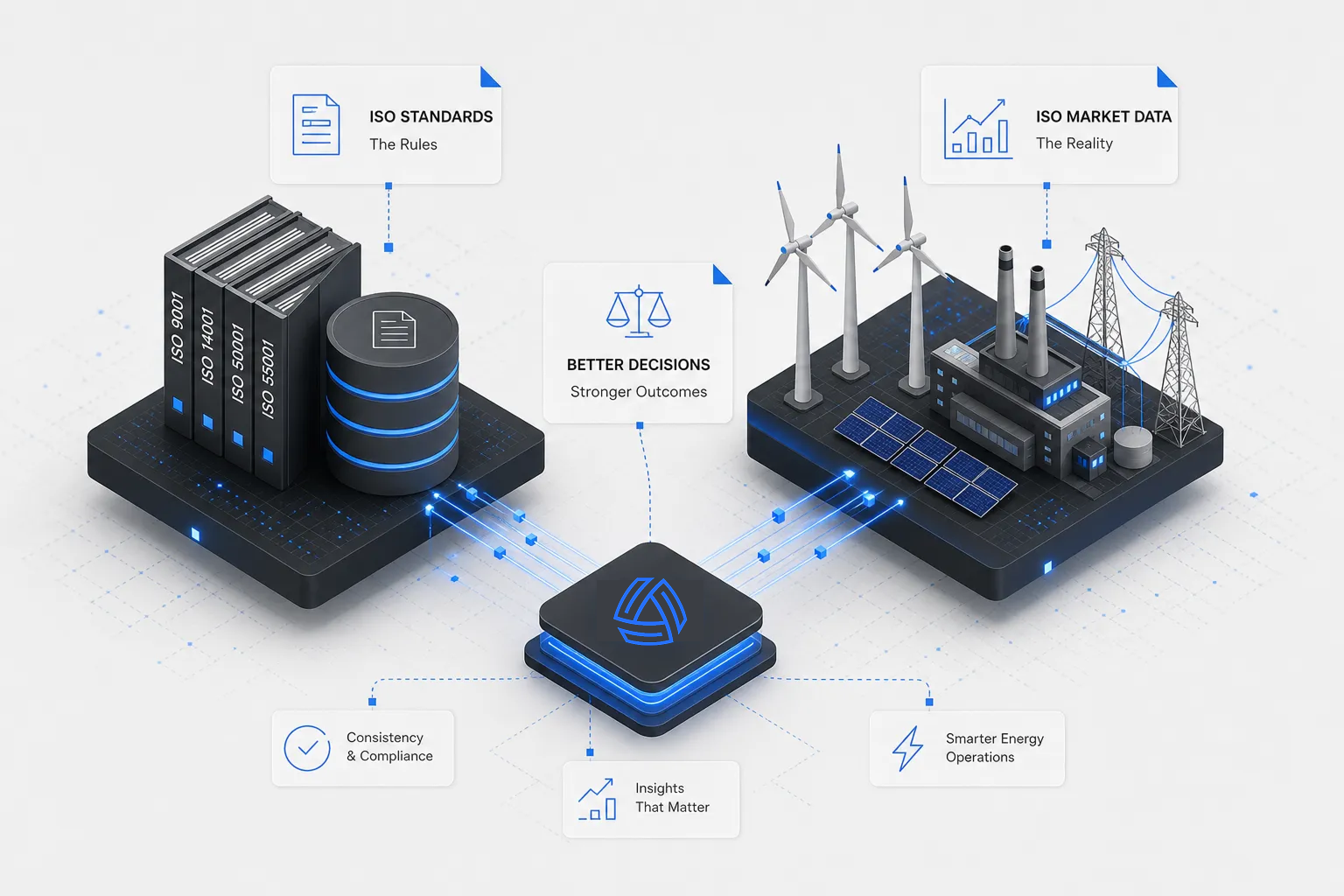
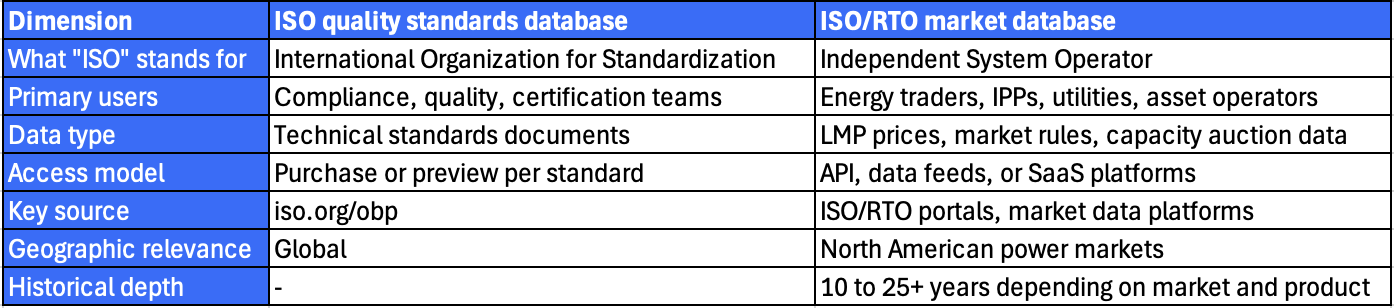
Search "ISO standards database" and you'll get two completely different results depending on which industry you work in. In quality management and compliance, ISO refers to the International Organization for Standardization, and its database is a catalog of over 24,000 technical documents covering everything from food safety to information security. In the energy industry, ISO is an acronym for Independent System Operator, and the databases that matter contain locational marginal prices, capacity auction results, ancillary service prices, and decades of wholesale electricity market data. These two things share three letters and nothing else.
For energy professionals, understanding this distinction isn't academic. Searching for an "ISO standards database" without that context can send you down the wrong path entirely, costing time and creating confusion about which data sources actually drive decisions.
This article covers both interpretations clearly, explains what each one contains, and lays out why ISO/RTO market data is the one that moves money in the power industry. Arcobi is built specifically around the latter, providing a structured ISO/RTO market data platform designed for power market professionals across North America.
Key takeaways
- Two meanings of ISO: In compliance, ISO means the International Organization for Standardization. In power markets, ISO means Independent System Operator. These are unrelated.
- OBP is a preview tool: The ISO Online Browsing Platform offers free access to selected introductory sections only. Full standards generally require purchase through the ISO Store, a national body, or an authorized reseller, though a limited number of documents are made publicly available in full.
- ISO/RTO data drives decisions: Power market participants rely on LMP prices, ancillary service data, and capacity auction results spanning 10 to 25+ years across PJM, ERCOT, MISO, CAISO, NYISO, ISO-NE, and SPP.
- Pipeline costs are significant: Building a proprietary multi-region ISO/RTO data pipeline typically costs $180,000 to $375,000 in engineering in year one, plus ongoing maintenance.
- Integrated platforms close the loop: Market-grade ISO/RTO platforms connect historical data, AI forecasting, and automated dispatch in a single system rather than requiring separate tools, evaluated by coverage breadth, normalization quality, latency, and historical depth.
What the ISO standards database means in quality and compliance
The ISO Online Browsing Platform (OBP), accessible at iso.org/obp, is ISO's official catalog for searching and previewing international standards, functioning as both an ISO standards database and an ISO standards lookup tool. It covers more than 24,000 standards across sectors ranging from food safety to information security. You can search by standard number, keyword, or exact phrase, and filter results by committee, technical sector, or publication date.
What you get for free is limited to the scope, foreword, normative references, and terms and definitions. A small number of ISO documents are made publicly available in full, but for the vast majority of standards, the full technical content, including requirements, annexes, and procedures, requires a purchase. For most standards, the OBP functions as a discovery and preview tool, not a library. Purchasing a full standard like ISO 9001 costs roughly CHF 158 (around US$175) directly from the ISO Store, or a comparable amount through national standards bodies like ANSI in the United States.
Authorized commercial resellers such as Accuris and Intertek Inform offer additional licensing options, including enterprise and multi-user access. For organizations managing large collections of standards across multiple users, those enterprise options are often more cost-effective than purchasing individual single-user documents. The OBP remains the authoritative place to verify a standard's title, edition, and current status before purchasing through any channel.
How to interpret an ISO standard reference
An ISO reference like ISO 9001:2015 encodes specific information: the standard number (9001), the organization (ISO), and the edition year (2015). That year identifies the edition, not a calendar year for review. ISO 9001:2015 is the fifth edition, published in September 2015, replacing ISO 9001:2008.
Amendments and corrigenda extend the notation further. An amendment looks like ISO 9001:2015/Amd 1:2024, which means Amendment 1 to the 2015 edition, published in 2024. A corrigendum corrects errors rather than making technical changes. These are distinct from a new edition, which receives a new year designation. For any controlled or contractual reference, verify the exact standard number, edition, amendment status, and current publication status in the ISO standards database before citing it.
The primary users of the ISO OBP are compliance managers, quality engineers, certification auditors, and procurement teams. Their goal is to verify a standard's current edition, check its status (published, under revision, or withdrawn), and obtain the full text for implementation or audit purposes. These professionals are an entirely different audience from power traders or energy asset operators, even though both groups sometimes search for an "ISO database."
How ISO/RTO market data is completely different
In North American power markets, ISO stands for Independent System Operator. An ISO, or its close relative an RTO (Regional Transmission Organization), manages the transmission grid, runs wholesale electricity markets, and publishes an enormous volume of market data. The major ISO/RTOs in the U.S. include PJM, ERCOT, MISO, CAISO, NYISO, ISO-NE, and SPP, each operating distinct markets with their own rules, pricing nodes, and data structures.
The data these operators publish is nothing like a standards catalog. It includes day-ahead and real-time locational marginal prices (LMP) at both the nodal and hub level, ancillary service clearing prices, capacity market auction results, fuel mix and emissions data, load and demand forecasts, and detailed market rules and tariff documents. The data is granular, often at the five-minute interval level, and spans years or decades. This is the information that drives dispatch decisions, trading strategies, portfolio optimization, and settlements.
Why power market participants need a comprehensive ISO/RTO data repository
A power trader working with incomplete LMP data misses price signals that can lead to materially different dispatch outcomes and significant financial exposure over a trading year. An IPP operating across PJM and MISO without unified historical data struggles to backtest strategies or validate forecasting models. A battery storage operator relying on fragmented data feeds from individual ISO portals faces latency, normalization headaches, and gaps in coverage that undermine real-time decision-making. In fast-moving wholesale power markets, data quality and completeness are competitive variables, not infrastructure questions.
The range of decisions that flow from ISO/RTO market data is broad. Energy traders use historical LMP data and bid stack information to model price patterns and calibrate forward positions. Generation and storage operators use real-time and day-ahead prices alongside ancillary service signals to optimize dispatch timing. Risk and settlements teams rely on accurate historical data to validate invoices and maintain regulatory compliance. Every one of these use cases requires data that is complete across regions, historically deep, and consistently normalized.
Historical depth matters more than most teams anticipate at the start. PJM day-ahead LMP data reaches back roughly 25 years, to around 2000. MISO archives go back to April 2005. CAISO hub-level data extends to around 2001 for some products. ERCOT's comparable hub-price history is shorter, around 12 years, reflecting the market's structure. For backtesting a dispatch strategy or validating an AI forecasting model, having at least three to five years of clean hourly data is the practical minimum; long-term studies often require 15 to 25 years of normalized records.
ISO standards database vs. ISO/RTO market database: what a market-grade system actually contains
A market-grade ISO/RTO database must cover locational marginal prices at the node and hub level in both day-ahead and real-time markets across all major ISO/RTO regions. It should also include ancillary service prices for products like regulation, spinning reserves, and operating reserves, along with capacity market auction results and forward curve data. Ancillary service price structures differ across the four major markets. PJM and CAISO provide the richest regulation price decomposition, including mileage and performance components. ERCOT primarily publishes product-specific capacity clearing prices (MCPCs). MISO publishes product-level clearing prices co-optimized with energy.
The data model complexity increases when you factor in nodal versus hub pricing. Nodal prices reflect individual transmission nodes, capturing local congestion directly. Hub prices aggregate across a defined set of nodes to provide a standardized trading reference. A participant whose physical node differs from the hub they trade against carries locational basis risk, which requires tracking both nodal and hub prices over time. A properly structured ISO/RTO database keeps nodal prices as the base fact table and derives hub prices separately, preserving the detailed physical signal while enabling efficient hub-level analytics.
Beyond price data, a comprehensive database includes the market rules and tariff documents that govern how those prices are set. Rule changes in PJM or ERCOT can materially shift market dynamics and need to be tracked alongside historical price data. Without that context layer, price anomalies in the historical record are difficult to interpret accurately.
How energy professionals can access ISO/RTO data without building their own pipelines
Most energy companies that rely on ISO/RTO data face one of two problems. They either pull raw data directly from individual ISO portals, which requires custom engineering for each region and produces data in incompatible formats, or they rely on point solutions that cover only one market or one data type. Building a proprietary pipeline covering five to seven ISO/RTOs, with hourly market data, several years of history, normalized identifiers, and production monitoring, typically requires 1,500 to 2,500 engineering hours. That scope carries a first-year budget of roughly $240,000 to $560,000 including infrastructure and maintenance. Neither raw portal scraping nor fragmented point solutions scales well across a multi-region portfolio.
Arcobi's self-service DataHub offers a commercial alternative designed to reduce or avoid that build cost. The platform provides normalized ISO/RTO market data covering PJM, ERCOT, MISO, CAISO, NYISO, ISO-NE, and SPP, accessible via API and query tools without building a proprietary data pipeline. Energy traders can pull LMP data at the node level, retrieve ancillary service price histories, access market rule documents, and feed that data directly into forecasting models or trading workflows through standard integrations. The normalization layer means a user can query PJM and CAISO with the same logic, without writing region-specific transformation code.
Access to comprehensive ISO/RTO market data is only valuable if it connects to decisions. Arcobi's platform integrates historical data, AI-driven price and demand forecasting, digital twin simulations, and automated dispatch in a single system. A generation or storage operator can use historical LMP data to calibrate a dispatch strategy, run that strategy through a digital twin simulation, and deploy automated dispatch signals, all within the same platform. That end-to-end connection is what separates a genuine ISO/RTO market intelligence platform from a data warehouse.
The ISO database you need depends entirely on your industry
If you work in quality management, certification, or compliance, the ISO Online Browsing Platform is your starting point for any ISO standards lookup. It's the authoritative source for international standards documents, and purchasing through the ISO Store or a national standards body like ANSI gives you a legally licensed copy to work from. Verify the standard number, edition, amendment status, and current publication status before purchasing, and confirm whether the license you need is single-user, multi-user, or enterprise before completing the transaction.
If you work in power markets, ISO means something different entirely, and the iso standards database that matters is one covering the complete range of North American ISO/RTO market data with the historical depth, regional breadth, and normalization quality that serious analysis requires. The operational and financial stakes in wholesale electricity markets are too high to rely on fragmented portal downloads or manually assembled data from multiple sources. Every significant decision, whether in trading, dispatch, settlements, or regulatory compliance, traces back to data quality.
Knowing which ISO you're dealing with is the first step. For quality and compliance teams, the right ISO standards database is the OBP and its authorized purchasing channels. For energy professionals operating across multiple markets, having a structured, normalized ISO/RTO market data platform behind you is the competitive edge, one that Arcobi's DataHub is built to deliver. Contact the Arcobi team to evaluate how the DataHub can replace your current data pipeline and integrate directly with your forecasting and dispatch workflows.
Frequently Asked Questions
How much does it cost to build a proprietary multi-region ISO/RTO data pipeline?
Building a proprietary multi-region ISO/RTO data pipeline typically costs in the ballpark of $240,000 to $560,000 in the first year, including infrastructure and maintenance. That scope corresponds to roughly 1,500 to 2,500 engineering hours, and a narrower engineering-only estimate runs about $180,000 to $375,000 in year one depending on coverage and complexity.
Can I get the full text of most ISO standards for free through the ISO Online Browsing Platform (OBP)?
No, the OBP provides only limited free content such as scope, foreword, normative references, and terms and definitions for most standards. A small number of ISO documents are made publicly available in full, but the vast majority require purchase through the ISO Store, a national body like ANSI, or an authorized reseller.
How much historical ISO/RTO market data is generally available for backtesting and forecasting?
Historical depth varies by market, with common ranges from about 10 to 25+ years depending on the ISO/RTO and product. For example, PJM day-ahead LMP data reaches back roughly 25 years to around 2000, MISO archives go back to April 2005, CAISO hub-level data extends to around 2001 for some products, and ERCOT hub-price history is shorter at around 12 years; practical backtesting typically needs at least three to five years of clean hourly data.
Can Arcobi’s DataHub replace my current ISO/RTO data pipeline and integrate with forecasting and dispatch workflows?
Yes, Arcobi’s DataHub is built to provide normalized ISO/RTO market data across major North American regions and to integrate historical data, AI forecasting, digital twin simulations, and automated dispatch in one platform. You can use the DataHub to feed LMPs, ancillary service histories, and market rules directly into forecasting models and dispatch workflows, and you should contact the Arcobi team to evaluate replacing your current pipeline.
Some Related Cases



Let's explore your energy challenge together.
Every energy challenge is different. Tell us yours, and
we'll show you what 25 years of market intelligence can do.
